

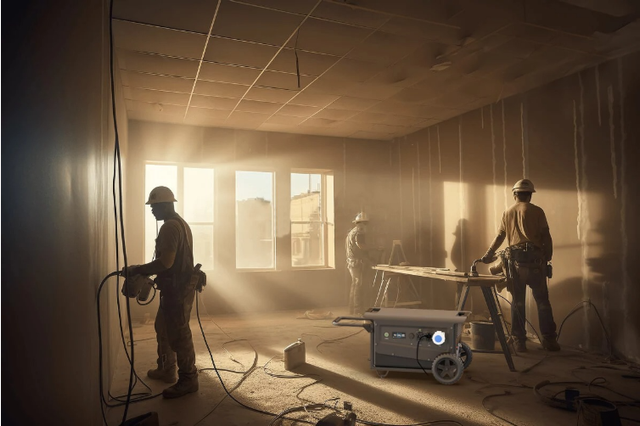
Commercial renovation is one of the most logistically demanding environments in construction. Contractors are working inside occupied or semi-occupied buildings, running power tools across multiple floors, managing temporary lighting in spaces where the existing electrical infrastructure has been stripped out, and trying to meet tight completion deadlines that leave no room for power failures or delays caused by grid access problems.
The traditional answer to this problem was a diesel generator parked outside the building. For decades it was the only practical option, and most contractors accepted the noise, the fumes, the fuel costs, and the maintenance requirements as unavoidable parts of the job. That is no longer the case. Modern Industrial Power Station systems have changed the calculus entirely, and contractors who have made the switch are not going back.
Why Grid Power Alone Does Not Work on Renovation Sites
The assumption that a commercial building under renovation has reliable grid access is often wrong. The electrical panels are frequently removed or taken offline early in the project. Floor by floor work means power needs to move with the crew rather than staying fixed to a single outlet location. And in buildings where live tenants or businesses occupy parts of the structure, drawing from the existing system is often not permitted at all.
Even where grid access exists, the infrastructure inside an older building being renovated may not support the load that modern tools require. Running a concrete grinder, a dust extraction unit, and work lighting simultaneously on a circuit that was sized for office use in 1985 is a reliable way to trip breakers and lose half an afternoon to an electrician sorting out a distribution problem.
Portable industrial power systems solve both of these problems at once. They travel with the crew, they plug in nothing, and they deliver the wattage that heavy commercial tools actually require without drawing on building infrastructure that may not be able to support it.
What the Equipment Needs to Handle
The power demands on a commercial renovation site are not trivial. Angle grinders typically draw between 1,000 and 2,500 watts. Heavy duty rotary hammers run from 1,200 to 1,500 watts. Dust extraction systems add another 1,000 to 2,000 watts on top of that. Work lighting across a full floor can add a further 500 to 1,500 watts depending on the setup.
A crew working a mid-size floor plate on a commercial renovation project can easily be drawing 6,000 to 8,000 watts at any given moment, not counting startup surge loads that spike two to three times higher than running wattage when motors first kick on.
This is why the capacity of an Industrial Power Station matters as much as its portability. SOUOP’s industrial range reaches 5,000 watts of continuous output with the ability to expand battery capacity through modular systems, which means a single unit can support a full crew’s tool load across a standard working day without requiring a recharge mid-shift. The pure sine wave output protects sensitive electronics and laser measurement tools that would otherwise be damaged by the dirty power a fuel generator produces.
The Noise and Fume Problem Nobody Talks About Enough
Every contractor who has used a diesel generator on an interior renovation job knows the problem. The exhaust fumes that seem manageable outside become a serious issue the moment windows are closed or work moves to a floor where ventilation is limited. The noise makes crew communication difficult and, in buildings with occupied neighboring spaces, creates friction with building management that can turn into costly project delays.
Battery based industrial power systems produce no emissions at the point of use and operate at noise levels low enough that a normal conversation can happen next to the unit. On renovation projects inside occupied commercial buildings, this is not a minor convenience. It is often the difference between being permitted to work during business hours and being restricted to evenings and weekends, which has a direct and significant impact on project cost.
Waterproofing and Site Durability
Renovation sites are wet environments. Concrete cutting generates water. Pipe work involves water. Rain comes through open facades during exterior work. A power system that cannot handle moisture exposure is a liability on any serious commercial renovation project.
SOUOP builds its industrial range to waterproof standards that address exactly this concern. The units are designed for deployment in genuine construction environments rather than controlled indoor settings, which is a meaningful distinction when the alternative is nursing a power system through conditions it was never rated for.
Recharging on a Multi Day Project
A common question from contractors evaluating battery industrial power systems for the first time is how recharging works across a multi-day project. The answer depends on the system, but modern units at the industrial end of the range support AC recharging from a single circuit overnight, and solar panel integration for sites where even temporary grid access is not available.
For renovation projects in heritage buildings or remote commercial properties where running a generator is not possible and grid connection has not yet been established, the solar charging option changes what is practically achievable. A system that arrives fully charged, runs a crew through a working day, and recharges from roof mounted panels overnight is a genuinely self-sufficient power source for the duration of a project.
The Cost Argument
Project managers evaluating industrial power systems against generator rental often focus on day rate comparisons and stop there. The full cost picture includes fuel, delivery and pickup logistics, scheduled maintenance during long rentals, noise complaints and the delays they cause, and the emissions compliance costs that are becoming increasingly relevant in urban renovation projects subject to air quality restrictions.
When these are factored in, battery based industrial power systems consistently show lower total cost over the duration of a commercial renovation project of any meaningful length. For contractors running multiple projects simultaneously, owning the equipment rather than renting generators across a fleet of sites delivers savings that compound quickly.
The shift away from diesel on commercial renovation sites is not happening because contractors have become environmentally motivated. It is happening because the performance is there, the economics have shifted, and the operational advantages on constrained urban sites are too significant to ignore any longer.